
PRDs and specs: what they are and how they're changing
 Emma BurrowsApril 9, 20264 min read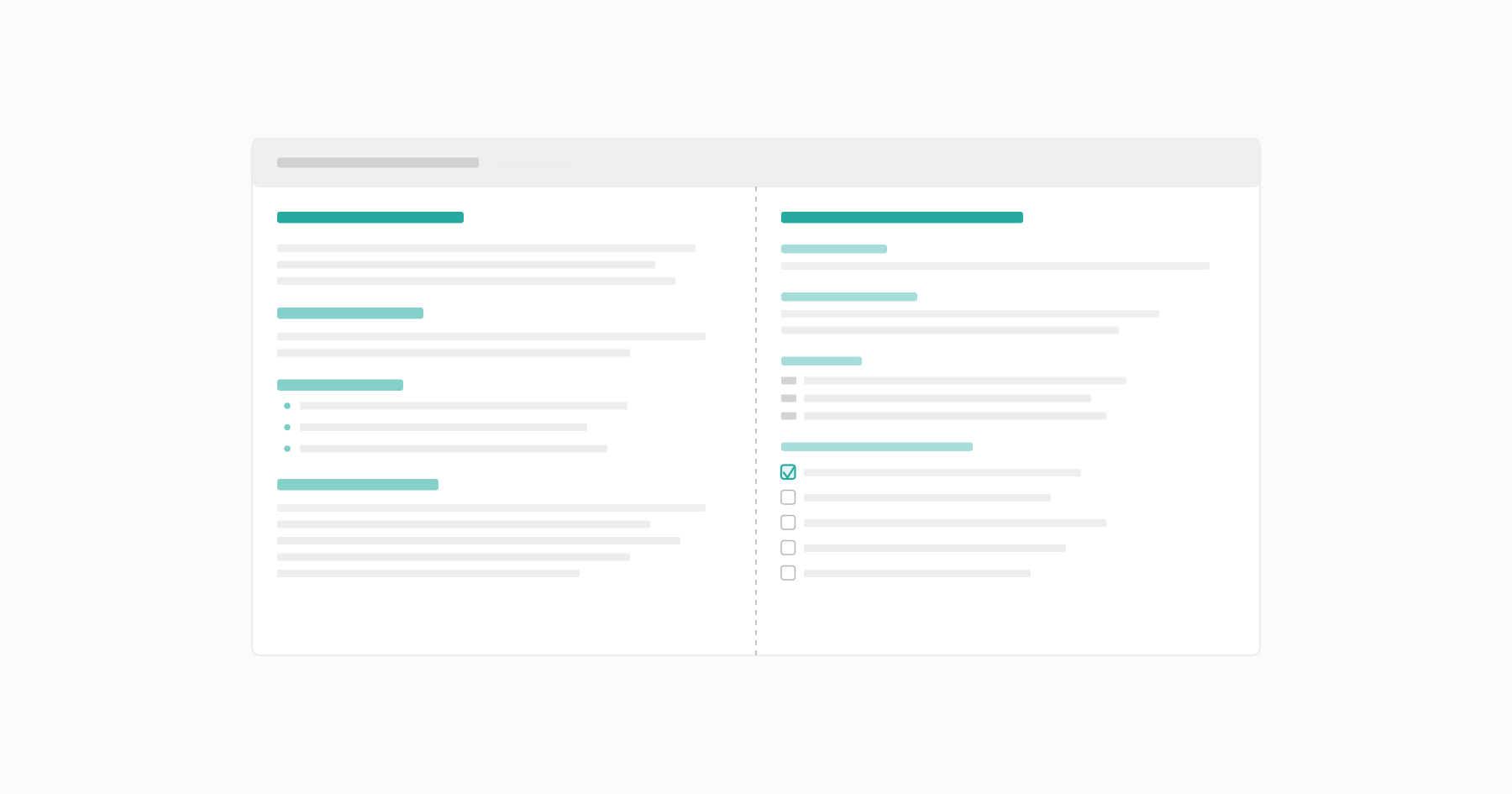
Ask ten product teams what they call the thing that describes what they're building and you'll get ten different answers. PRD, spec, brief, requirements doc, design doc, prompt.
The terminology has always been inconsistent — not because teams don't know what they're talking about, but because the same concepts travel under different names depending on company size, industry and people's experience.
Yes, it's partly semantics, but we think it's worth clearing up. The way software gets built is changing fast, and these documents are becoming more important, not less.
The definitions
A PRD is fundamentally a thinking tool. Its primary objective is to describe the rationale for a product decision and drive alignment. It outlines who has the problem, what outcome you're aiming for, and why this approach over the alternatives. The audience is human: your team, your stakeholders, whoever needs to understand the reasoning before anyone opens a code editor.
A PRD is typically written by a PM and critiqued or improved by an agent, but the PM owns it. It succeeds when it aligns people around the right problem before they start building, and it fails when it's vague or too focused on the solution.
A spec is a structured set of instructions for a coding agent. Its objective is execution, and the audience is not a human but the agent running the session. The content reflects that: context that lives outside the repo (design decisions, adjacent systems, product history that isn't in the codebase), a precise feature description, technical guidelines, and acceptance criteria the agent can actually test against.
A spec is written by an agent and then critiqued and improved by a human, whose job is to make it more precise, not more readable.
PRDs vs Specs at a glance
Why does this matter, anyway?
You might think that for a world of AI-pilled teams where "coding is solved", none of this will matter. After all, this is just a matter of internal process and bureaucracy.
Except it isn't.
AI has accelerated code generation exponentially, and in doing so, it shifted the bottleneck of software development upstream. When coding agents can ship a feature in hours, the constraint is no longer "can we build this" but "should we build this, and are we building it right."
That puts far more weight on the quality of thinking that happens before the build — which means that product builders should care deeply about the process that takes them from a new idea to implementation.
To ensure that thinking is high-quality, it is often helpful to separate PRDs and specs. That way, you'll avoid having one person trying to work through the what, the why, and the how at the same time. That's genuinely hard to do well, and most people don't.
How you're writing PRDs says something about your org
How your team writes PRDs and handles the PRD-spec relationship is a proxy for how close product is to engineering.
If your team always keeps them separate — PM writes the PRD, someone else converts it to a spec, spec goes to the agent — you're running a handoff model. Work happens in sequence: product throws it over the wall before engineering (or the agent) picks it up. That's a legitimate approach, but if the separation is always strict and clean, it usually means Product isn't shipping features in production.
If your team is starting to merge them — treating a single document as both the thinking artifact and the agent instructions — you're probably closing that gap. If you still produce the two artifacts — PRD and spec — but the same person is crafting both, it means your team is collapsing product and engineering into a single function. We expect most 'product builders' to work that way.
Neither pattern is intrinsically better than the other, but it's worth knowing which one you're running and what fits your team better.
Create PRDs and specs in Rezonant
We're launching document generation in Rezonant — you can now use it to create both PRDs and specs, with the separation between them built into the workflow. Rezonant is the collaborative workspace where AI-native teams transform product ideas into reality: it aggregates context from your codebase and the tools where your product knowledge lives, so the documents you produce are grounded in what your team already knows rather than starting from a blank page.