
Sales-led vs. product-led teams: how to set up your feedback loops
 Emma BurrowsJuly 24, 20263 min read
Products are getting quicker to build, and teams are facing the question of what to build - and why - far more often than they used to.
It used to be that you could take your time on an idea: your engineers would spend a few weeks building it, which gave you room to work out your next move. Now that coding is fast and cheap, you need more good ideas, more often, just to keep pace with your engineers.
Working out what to build next comes down to gathering enough data (qualitative or quantitative) to know whether a hunch is worth backing, and the best way to do that is with a feedback loop: collecting user data, spotting patterns, acting on what you learn, and communicating the changes back to users.
We wrote about feedback loops in a recent post, with the rough steps being:
- Articulate what you're building, who it's for, and why.
- Prototype internally. Show it to a proxy of your users first. You'll catch obvious UX confusion and streamline the flow before anyone external sees it.
- Prototype externally. Show it to your most engaged users to find out if it solves a real pain point. How you do this depends on whether you're sales-led (show your clients) or product-led (show a user research group).
- Ship a test. More teams now ship a feature before it's fully finished, because live usage tells you things nothing else can. This usually sits behind a feature flag, so you learn from a subset of users before rolling out further.
- Ship the full feature. By now you should have enough signal to know if the idea holds up. If it does, ship company-wide and keep iterating from there.
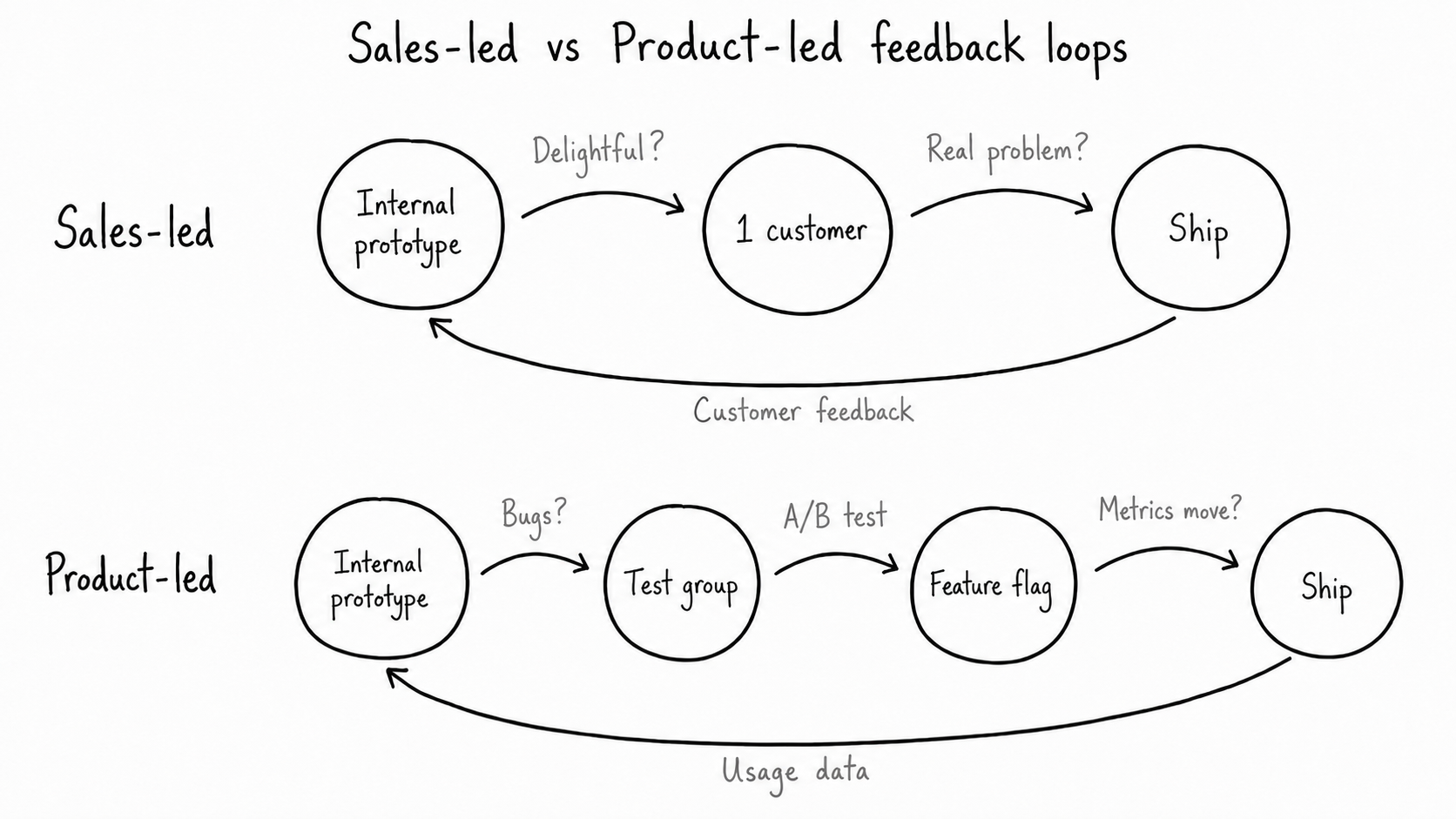
These loops look different in sales-led vs. product-led teams
In an AI-native environment, it's tempting to assume every team should work the same way: build quickly, show something early, iterate fast, ship often.
There's some truth to that, but every business has its own nuances that one-size-fits-all frameworks often don't accommodate. One of the biggest forks is whether your business grows through product-led growth (PLG) or sales-led growth (SLG).
PLG uses the product itself as the main way to acquire, retain, and expand users, usually through free trials and self-serve signups. SLG relies on human sales teams to walk prospects through demos, negotiations, and contracts.
That difference changes where your best feedback loops sit.
Sales-led teams iterate with a few clients
In a sales-led company, the PM works closely with a small set of high-value clients and shapes decisions around their explicit requests. The flow usually looks like:
- Prototype internally. Show the team, iron out the obvious kinks.
- Prototype with one client. Show a few options, align on a direction.
- Ship the full thing. Tweak for other clients and roll out where it fits.
Product-led teams iterate at scale
In a product-led company, you have far more usage data to lean on. As a PM, you're hunting for patterns across thousands of feedback points, and the skillset shifts toward data analysis and loop design. That flow usually looks like:
- Prototype internally. Show the team.
- Prototype with a test group. Show a slice of real users.
- Ship a test. Behind a feature flag, to see early real usage.
- Ship the full thing. Roll out to all users.
Where AI fits in
Across both motions, AI can now pick up a lot of the manual work in this loop: drafting the PRD from raw feedback, building the first prototype, even opening the PR. The more clearly you've mapped where your feedback loops sit, the more of that work you can hand off - and the higher up the stack you get to operate.
That shift also raises a new question: how far should you let a non-technical business person go in shipping a feature? In a sales-led team, that might mean giving sales reps the ability to ship small features themselves. In a product-led team, it might be marketers shipping their own landing page tests. Either way, the logic holds: as building gets cheaper, more people on the team become builders, not just engineering.